
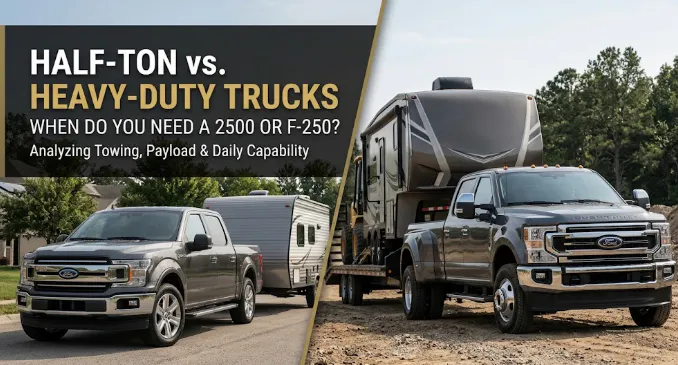
Half-Ton vs. Heavy-Duty Truck: When Do You Need a 2500 or F-250?
City Auto Used Truck Guide
Half-Ton vs. Heavy-Duty Truck: When Do You Need a 2500 or F-250?
Learn when an F-150, Silverado 1500, or Ram 1500 is enough—and when payload, tongue weight, towing, and regular heavy use make an F-250, Silverado 2500 HD, or Ram 2500 the better fit.
A half-ton pickup can tow a surprisingly heavy trailer. That does not mean a half-ton is always the right truck for a heavy trailer.
The real dividing line between trucks such as the Ford F-150, Chevrolet Silverado 1500, and Ram 1500 and heavy-duty pickups such as the F-250 Super Duty, Silverado 2500 HD, and Ram 2500 often comes down to payload, tongue weight, GVWR, GCWR, chassis capacity, and how frequently you tow.
A properly configured half-ton may have enough maximum trailer rating for your camper or equipment trailer on paper, but passengers, cargo, accessories, and trailer tongue weight can consume its available payload surprisingly quickly.
Quick Answer
A half-ton truck is usually the better fit for daily driving, lighter-to-moderate towing, boats, utility trailers, and many recreational trailers. Consider stepping up to an F-250, Silverado 2500 HD, or Ram 2500 when payload or tongue weight becomes the limiting factor, you regularly tow heavier trailers, you need fifth-wheel or gooseneck capability, or you want more capacity margin.
Half-Ton vs. Heavy-Duty Truck Guide
What Separates a 1500 From a 2500?
Terms such as “half-ton” and “three-quarter-ton” are traditional pickup classifications. They do not mean a modern F-150 can carry exactly 1,000 pounds or a Silverado 2500 can carry exactly 1,500 pounds.
The useful distinction today is between light-duty full-size pickups and heavy-duty pickups.
| Light-Duty / Half-Ton | Heavy-Duty / 2500-Class |
|---|---|
| Ford F-150 | Ford F-250 Super Duty |
| Chevrolet Silverado 1500 | Chevrolet Silverado 2500 HD |
| Ram 1500 | Ram 2500 |
| GMC Sierra 1500 | GMC Sierra 2500 HD |
GVWR, Payload, and GCWR Explained
GVWR: The maximum allowable loaded weight of the truck itself.
Payload: The weight the truck can carry, including people, cargo, accessories, and trailer tongue or pin weight.
GCWR: The maximum allowable combined loaded weight of the truck and trailer.
A towing setup has to remain within all applicable trailer, GVWR, axle, payload, hitch, and GCWR limits.
Frame, Suspension, and Axles
Heavy-duty pickups generally use more substantial:
- Frame components
- Rear axles
- Springs
- Wheel bearings
- Brakes
- Cooling systems
- Wheels and tires
- Driveline components
That additional capacity can improve control under significant load, but a heavy-duty truck will generally feel larger and firmer when driven empty.
Why the Rating Label Matters More Than the Badge
Two trucks wearing the same badge can have different payload ratings. Diesel engines, larger cabs, four-wheel drive, luxury equipment, off-road packages, larger wheels, and accessories all add weight.
Used-shopping tip: Check the actual certification and Tire and Loading Information labels on the truck. The vehicle-specific rating is more useful than a model-wide maximum.
Matching the Truck to the Trailer
The trailer should determine the truck—not the other way around. Start by figuring out what the trailer will actually weigh when loaded.
Trailer Weight vs. Tongue Weight
Imagine a travel trailer with a loaded weight of 9,000 pounds. A half-ton with a 12,000-pound maximum tow rating may appear to have plenty of capacity.
But a conventional trailer may place roughly 10 to 15 percent of its loaded weight on the hitch. A 9,000-pound trailer can therefore contribute roughly 900 to 1,350 pounds of tongue weight before you add passengers, luggage, tools, cargo, and accessories.
That is why payload can become the limiting factor before maximum trailer weight.
| Category | Half-Ton | Heavy-Duty |
|---|---|---|
| Everyday driving | Generally easier and more comfortable | Larger and typically firmer |
| Parking | Easier | More space required |
| Payload | Can become limiting with large trailers | Generally much greater capacity |
| Conventional towing | Excellent for many boats and campers | Greater margin for heavy trailers |
| Fifth-wheel / gooseneck | Limited by payload and configuration | Much better suited |
| Operating cost | Generally lower | Generally higher |
Current Trucks Show How Wide the Gap Can Be
| 2026 Example | Class | Maximum Available Towing |
|---|---|---|
| Ford F-150 | Half-ton | 13,500 lbs. |
| Chevrolet Silverado 1500 | Half-ton | 13,300 lbs. |
| Ram 1500 | Half-ton | 11,610 lbs. |
| Ford F-250 Super Duty | Heavy-duty | 20,000+ lbs. in properly configured applications |
| Chevrolet Silverado 2500 HD | Heavy-duty | Up to 22,420 lbs. |
| Ram 2500 | Heavy-duty | Up to 20,000 lbs. |
Maximum available ratings shown for class comparison only. Hitch type, engine, cab, bed, drivetrain, axle ratio, equipment, payload, passengers, and cargo can significantly change the rating of an individual truck.
When a Half-Ton Is Probably Enough
- The truck is primarily a daily driver.
- You tow occasionally rather than constantly.
- Loaded trailer weight is comfortably below the truck’s rating.
- Tongue weight, passengers, and cargo fit comfortably within payload.
- You do not need a large fifth-wheel or gooseneck trailer.
- You value easier parking and a more compliant unloaded ride.
When It Is Time to Look at a 2500 or F-250
- Payload is close to the half-ton’s limit.
- Tongue or pin weight is high.
- You tow heavy trailers regularly.
- You are shopping for a large travel trailer.
- You tow horse or equipment trailers.
- You need fifth-wheel or gooseneck capability.
- You carry significant bed cargo while towing.
- You want more capacity margin instead of operating near maximum ratings.
Compare Truck Classes
Shop Used Trucks at City Auto
Compare light-duty and heavy-duty trucks by engine, drivetrain, cab, mileage, equipment, and price.
Gas vs. Diesel in Used Heavy-Duty Trucks
Once you move into F-250, Silverado 2500 HD, and Ram 2500 territory, both gas and diesel engines can make sense.
Gas Heavy-Duty Trucks
Gas engines generally offer:
- Lower initial purchase cost
- Simpler emissions hardware
- Lower-cost routine service in many cases
- Strong payload capacity
- Plenty of capability for many work and recreational trailers
Current heavy-duty gas options include Ford’s gas V8s, Chevrolet’s 6.6L gas V8, and Ram’s 6.4L HEMI V8.
Diesel Heavy-Duty Trucks
Major diesel choices include:
- Ford 6.7L Power Stroke V8
- Chevrolet 6.6L Duramax V8
- Ram 6.7L Cummins inline-six
Diesels generally provide much greater low-rpm torque and commonly carry the highest towing ratings in a heavy-duty lineup.
More Torque Does Not Automatically Mean More Payload
Diesel engines are heavy. That weight becomes part of the truck before passengers or cargo are added.
For example, Ram lists up to 3,930 pounds of payload for a properly configured 2026 Ram 2500 with the 6.4L gas V8 compared with up to 3,600 pounds with the Cummins diesel.
Gas vs. diesel rule: If trailer weight is the challenge, diesel may have the advantage. If payload is the challenge, do not assume diesel automatically wins.
Diesel Maintenance and Running-Cost Considerations
Depending on model year, diesel ownership can add considerations such as:
- Diesel exhaust fluid
- Diesel particulate filters
- Additional emissions-system hardware
- Fuel-filter service
- Larger oil capacity
- Potentially higher repair costs for some components
If you are evaluating a used diesel, service history matters. If you do not need diesel-level towing capability, compare total ownership cost before paying extra for it.
Silverado 2500 HD vs. F-250 vs. Ram 2500 at a Glance
Ford F-250 Super Duty
The F-250 is Ford’s first step above the F-150. Used shoppers can encounter gas and Power Stroke diesel engines, Regular Cab, SuperCab, and Crew Cab layouts, multiple axle ratios, 4×2 and 4×4 drivetrains, and conventional, fifth-wheel, or gooseneck towing configurations.
Chevrolet Silverado 2500 HD
Silverado 2500 HD is the heavy-duty step above the Silverado 1500. Recent versions use either a 6.6L gasoline V8 or available 6.6L Duramax turbo-diesel V8, with the diesel carrying the highest maximum towing ratings.
Ram 2500
Ram 2500 offers gas HEMI and Cummins diesel choices. For 2026, Ram lists up to 17,750 pounds of towing with the gas V8 and up to 20,000 pounds with the Cummins diesel.
Which Heavy-Duty Truck Is Best?
Compare the individual truck on:
- Actual payload
- Engine
- Axle ratio
- Cab and bed
- Drivetrain
- Hitch type and towing equipment
- GCWR
- Mileage
- Service history
- Condition
- Price
What to Check on a Used Heavy-Duty Truck
Check the Vehicle’s Rating Labels
Review GVWR, front and rear GAWR, Tire and Loading Information, and available payload. Do not rely only on online specifications.
Look at the Hitch and Towing Equipment
- Receiver-hitch condition
- Fifth-wheel or gooseneck mounting hardware
- Trailer wiring
- Trailer-brake controller
- Bent or damaged components
- Excessive corrosion
Check the Bed
Look for fifth-wheel or gooseneck hardware, drilled holes, dents, heavy impact damage, chemical stains, corrosion, and damaged bed rails.
Inspect the Suspension, Steering, and Tires
Pay attention to steering play, pulling, vibration, clunks, uneven tire wear, suspension noise, tire size, load rating, tread, and sidewall condition.
Diesel Buyers Should Review Service History Carefully
Ask about:
- Oil-change history
- Fuel-filter service
- Cooling-system service
- Transmission service
- Emissions-system repairs
- DEF-system issues
- Previous warning lights
Check for Modifications
Common heavy-duty modifications include:
- Suspension lifts
- Oversized tires
- Tuners
- Aftermarket wheels
- Auxiliary fuel tanks
- Airbags or helper springs
Understand what was changed before buying because modifications can affect ride, gearing, emissions compliance, payload, and towing behavior.
The Real Question: How Much Margin Do You Want?
Truck shopping is not only about finding a vehicle whose published maximum is one pound higher than your trailer.
If you tow a 7,000-pound boat a few weekends each year, a properly configured half-ton may be ideal.
If you regularly tow a large camper while carrying a family, tools, coolers, a generator, and cargo in the bed, payload may push you toward a heavy-duty truck even though the trailer itself fits under a half-ton’s maximum tow rating.
If you tow a heavy equipment or horse trailer every week, the additional chassis, braking, axle, payload, and GCWR capacity of a 2500 or F-250 can become more important than unloaded ride comfort.
Choose the class based on your normal loaded use—not the largest number in a brochure.
Key Takeaways
- “Half-ton” and “three-quarter-ton” are traditional class names, not literal modern payload ratings.
- F-150, Silverado 1500, and Ram 1500 are light-duty full-size trucks.
- F-250, Silverado 2500 HD, and Ram 2500 are heavy-duty trucks.
- Half-ton trucks already offer substantial towing capability.
- Heavy-duty trucks generally provide higher payload, GVWR, GCWR, and towing capability.
- Payload often becomes the reason to move from a 1500 to a 2500 before maximum trailer weight does.
- Trailer tongue or fifth-wheel pin weight counts against payload.
- Gas HD trucks may offer more payload than comparable diesels.
- Diesels generally offer higher towing capability but can cost more to purchase and maintain.
- Check the actual truck’s door-jamb ratings before choosing it for a trailer.
Frequently Asked Questions
What is the difference between a half-ton and a three-quarter-ton truck?
Modern half-ton and three-quarter-ton names describe pickup classes rather than exact payload capacities. Half-tons such as the F-150, Silverado 1500, and Ram 1500 are light-duty trucks, while the F-250, Silverado 2500 HD, and Ram 2500 use heavier-duty components designed for greater loads.
Is a 2500 truck a three-quarter-ton?
Yes. Silverado 2500 HD and Ram 2500 are commonly described as three-quarter-ton or heavy-duty pickups. Ford uses F-250 for the corresponding Super Duty class.
How do I know if I need a 2500 instead of a 1500?
Look at loaded trailer weight, tongue or pin weight, payload, GVWR, axle ratings, and GCWR. A 2500 or F-250 becomes especially useful when payload is tight, the trailer is heavy, towing is frequent, or you need fifth-wheel or gooseneck capability.
Can a half-ton tow 10,000 pounds?
Many properly configured modern half-ton trucks can. That does not mean every F-150, Silverado 1500, or Ram 1500 can tow 10,000 pounds, and payload may become the limiting factor first.
Is an F-250 better than an F-150 for towing?
An F-250 generally offers substantially greater heavy-duty capacity. An F-150 may still be the better choice when the trailer fits comfortably within its limits and everyday comfort, maneuverability, and operating costs matter more.
Is a Silverado 2500 HD bigger than a Silverado 1500?
Yes. Silverado 2500 HD is a heavy-duty truck with chassis, suspension, axle, braking, and powertrain specifications designed for greater loads than Silverado 1500.
Is a Ram 2500 better than a Ram 1500?
It depends on the job. Ram 2500 offers greater heavy-duty capability, while Ram 1500 is generally easier to use as an everyday truck. If you do not need the additional payload or towing capacity, the 1500 may be the better fit.
Do I need a diesel 2500 to tow a camper?
Not necessarily. Heavy-duty gas engines can tow substantial trailers. Diesel becomes more attractive as trailer weight and towing frequency increase.
Does diesel increase payload?
Not necessarily. Diesel engines are heavier than comparable gas engines, so a gas truck may have more available payload even when the diesel has a higher maximum towing rating.
What is tongue weight?
Tongue weight is the downward load a conventional trailer places on the hitch. It counts against the truck’s available payload along with passengers and cargo.
What is pin weight?
Pin weight is the portion of a fifth-wheel trailer’s weight carried in the bed through the fifth-wheel hitch. It can consume a significant amount of payload.
Should I buy a heavy-duty truck if my trailer is close to my half-ton’s limit?
It is worth comparing one. Operating near multiple limits leaves less room for passengers, cargo, accessories, and changes in trailer loading. A heavy-duty truck may provide more usable capacity margin.
See a CAzillion. Find the One.
Compare Half-Ton and Heavy-Duty Trucks at City Auto
Start with what you need to carry and tow, then compare trucks by payload, engine, drivetrain, cab, bed, towing equipment, mileage, condition, and price.
More Used Truck Guides From City Auto
Truck Comparison
Ford F-150 vs. Chevy Silverado 1500 by Model Year
Compare two popular half-ton pickups across engines, towing, MPG, generations, and configurations.
Ford Towing Guide
Ford F-150 Towing Capacity by Year and Engine
See how F-150 towing changes by engine, drivetrain, axle ratio, cab, bed, and model year.
Chevrolet Towing Guide
Chevy Silverado 1500 Towing Capacity by Year and Engine
Compare Silverado 1500 ratings by model year, engine, drivetrain, and configuration.
Drivetrain Guide
AWD vs. 4WD: What’s the Difference and Which Do You Need?
Learn how AWD and 4WD differ and what to check when buying a used truck or SUV.
